Handstands, Hopscotch and a Bit of Bossy Skipping: Twelve Playground Games to Hand Down in 2026
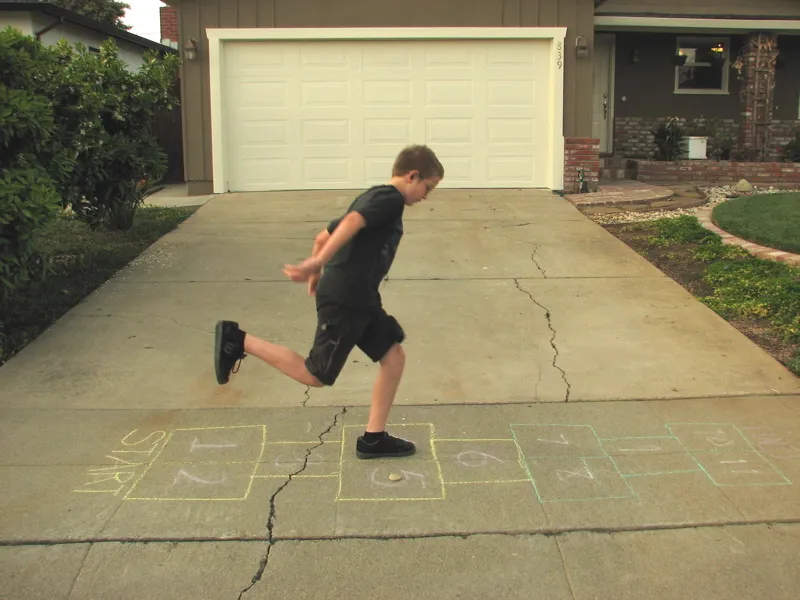
Photo: Lenore Edman, CC BY 2.0, via Wikimedia Commons
There is a particular sound that used to drift out of every UK playground at breaktime: the slap of plimsolls on tarmac, a skipping rope whipping the ground, and somebody shouting the rules of a game they were definitely making up as they went along. In 2026, that sound is rarer. Not gone, mind, just drowned out by the general hubbub of trim trails, football cages and the siren call of a screen at home. Which is a shame, because most of these games cost almost nothing, need no charging cable, and teach children how to lose, negotiate, take turns and get mildly bossy about whose go it is. All essential life skills, frankly.
So here is the Hop Skip Jump breaktime handover: twelve classics worth teaching your lot this weekend. Try one on the pavement, one at the school gate while you wait for the doors to open, or one in the park with a bag of chalks and a slightly bemused grandparent. No app required.
Why bother with the old-school stuff?
Because it works. Playground games are a sneaky package deal: physical activity, social glue and a bit of light rule-making all in one. They are also brilliant for mixed ages. A five-year-old can play What's the Time, Mr Wolf? with an eight-year-old and nobody has to pretend the little one is winning. Unlike a structured club or a paid-for activity, there is no kit list, no booking fee and no wet-weather cancellation email. Just a bit of chalk, a tennis ball and the willingness to look slightly daft in front of the neighbours.
They are also a gentle lesson in resilience. You get out. You wait. You argue about whether the foot was over the line. You play again. That is the whole curriculum.
The kit: about £8 and a rummage
You do not need much. A box of pavement chalk, a long skipping rope, a couple of tennis balls, a pack of wide elastic (the sort sold for sewing or gymnastics works well), and a few conkers if it is autumn. Add a stopwatch if you are the sort of family who likes a leaderboard. That is genuinely it. A hopscotch grid can be drawn with a stone on dry pavement, and a clapping rhyme needs nothing but hands.
The twelve, in roughly rising order of chaos
1. Hopscotch. The gateway game. Chalk a grid of squares numbered one to ten, with a pair of side-by-side squares at four-five and seven-eight. Players throw a stone onto a number, then hop the grid, landing two feet in the paired squares, turning at the top and collecting the stone on the way back. Age four and up. Master tip: draw it big. Tiny grids are a false economy.
2. What's the Time, Mr Wolf? One child is the wolf, back turned. The line of players chants the question. The wolf answers with a number, and everyone takes that many steps. When the wolf says 'dinner time', it is a chase back to the start line. Age four and up. Excellent for teaching the difference between a sprint and a shriek.
3. Elastics, a.k.a. French skipping. Two players hold the elastic around their ankles. The jumper performs a set sequence — in, out, on, off — while chanting. If they complete it, the elastic rises to knees, then thighs, then waist. Age six and up. This one is quietly addictive and produces the best arguments about whose foot touched the elastic.
4. Clapping rhymes. Face a partner. Clap your own hands, then right-to-right, left-to-left, and repeat, while chanting something like 'A Sailor Went to Sea'. Speed up until somebody collapses. Age five and up. No equipment, no mess, and it works on a wet Wednesday in the hallway.
5. Please, Mr Crocodile. The crocodile stands in the middle of the 'river'. Players shout, 'Please, Mr Crocodile, can we cross the river?' The crocodile replies with a condition — 'only if you are wearing blue' or 'only if you have a brother' — and the eligible players dash across. Age four and up. The crocodile is the best role, obviously.
6. Grandmother's Footsteps. Grandmother stands at one end with her back turned. Everyone creeps forward. She spins around; everyone freezes. Anyone caught moving is sent back. Age four and up. Deceptively simple, genuinely tense.
7. Stuck in the Mud. A tag game with a twist. Anyone tagged freezes with their legs apart. A free player can crawl through their legs to release them. Age five and up. Best played on grass, or at least somewhere with a forgiving surface.
8. Duck, Duck, Goose. Everyone sits in a circle. One player walks around, tapping heads and saying 'duck' until they choose a 'goose'. The goose chases them around the circle and tries to steal the empty spot. Age four and up. Warning: this one can go on for a while, and the goose always feels hard done by.
9. Queenie, Queenie. One player hides a small ball behind their back while the others chant, 'Queenie, Queenie, who's got the ball?' The guesser has to work out who is holding it. Age six and up. A lovely quiet one for the end of a party when everyone is overexcited.
10. Kick the Can. One guard, one can, and a pile of hiding players. The guard counts while everyone hides, then tries to spot them. A spotted player can be freed if someone else kicks the can over. Age seven and up. This one needs a bit of space and a clear boundary, but it is worth the effort.
11. Conkers. Autumn only, and check your school's rules first. Drill a hole, thread a string, knot it, and take turns striking. The first conker to shatter loses. Age six and up, with a sensible chat about not swinging anywhere near faces. A genuine British classic, and no, a plastic conker does not count.
12. Two-ball. Find a wall. Bounce two tennis balls against it in a pattern while chanting a rhyme. Start simple — one bounce, catch, swap hands — and build up. Age seven and up. It looks easy and is not, which makes it perfect for a bit of competitive parent-child nonsense.
School-gate etiquette and pavement politics
A few practical notes. Chalk washes off, but check you are not drawing on a neighbour's freshly painted wall. Skipping ropes and busy pavements do not mix, so find a quiet bit of tarmac or a park path. If you are teaching a game at the school gate, keep it short and cheerful — three minutes is plenty, and nobody wants to be the parent holding up the pickup queue with a hopscotch lecture.
Also, resist the urge to referee everything. Part of the joy of these games is that children learn to sort out the rules themselves. Step in if somebody is genuinely upset, obviously. Otherwise, let the eight-year-old explain the elastic sequence in her own words. She will do a better job than you anyway.
Start with one this weekend
Pick a game. Any game. Draw a hopscotch grid on the pavement outside the house, or dig out a tennis ball and have a go at two-ball against the garden wall. Teach one to your child, then let them teach it to a friend. That is how these things survive — not through a national campaign, but through one slightly wobbly game of What's the Time, Mr Wolf? at the school gate on a Friday afternoon. Go on. The pavement is free.