Socks Off at Four, Home by Six: The After-School Birthday That Actually Works in 2026

There is a particular kind of birthday-party chaos that begins at 2pm on a Saturday: the hall is booked for three hours, the bouncy castle has been inflated, forty small guests are due, and somebody has already lost a shoe. It is glorious, of course. It is also expensive, sprawling and capable of eating an entire weekend.
Enter the after-school party. Straight from the school gate, into the hall, a quick blast of games, tea at a sensible hour, cake, coats on, home by six. No Saturday sacrifice. No Sunday recovery. No three-hour slot to fill with increasingly tired children. Done properly, the 4pm–6pm birthday is less of a compromise and more of a quiet revolution — especially for primary-age children who are still young enough to love a disco and old enough to follow a countdown.
Why 4pm is secretly the sweet spot
Children arrive already in party mode because school is out and the day has switched gears. They have had lunch, they have had a runabout at break, and they are usually hungry enough to eat proper tea without a battle. The window is short, which sounds restrictive but actually helps: nobody has time to get bored, and nobody has time to start sliding under tables.
It also respects the school-night routine. A 4pm start means a 6pm finish, which means home, bath, book and bed are still genuinely possible. For parents of reception and key stage 1 children, that is not a small thing. For key stage 2 children, it still leaves enough evening for homework and a bit of decompression. And for you, the host, it means the party has a natural full stop rather than a slow, sticky fade.
The 90-minute running order
Treat the two-hour booking as a 90-minute party with a 30-minute buffer for arrival, coats and the inevitable hunt for a lost cardigan.
3.45pm: You arrive with the food, the cake and a printed checklist. Put out water jugs, label the cake table, and set the first game up before anyone appears.
4.00pm: Guests arrive. Name stickers, shoes off, water bottles on the side. Keep this bit simple. A colouring sheet on the table buys you five minutes while the stragglers trickle in.
4.15pm: High-energy games. Start with something loud and silly — musical statues, a beanbag relay or a quick disco warm-up. This burns off the after-school wriggles before tea.
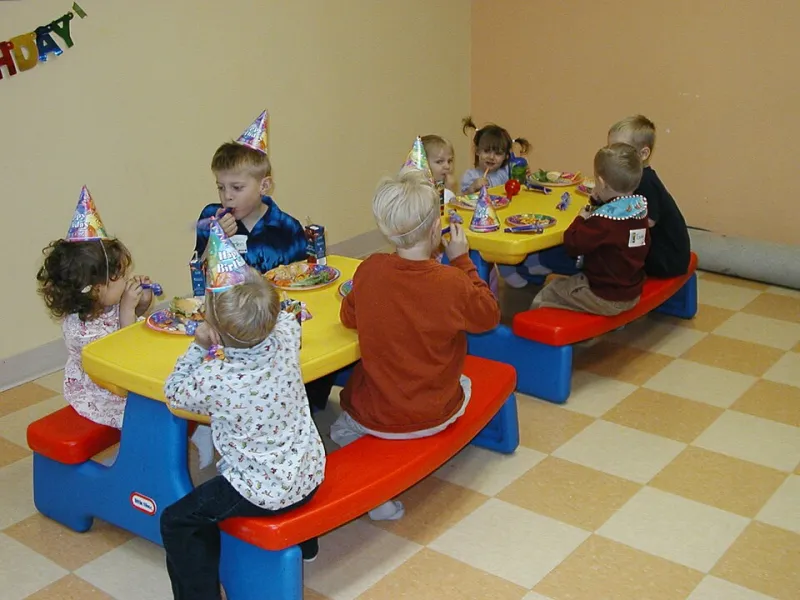
4.45pm: Food. Sit them down properly. Teatime food works best when it is familiar, easy to hold and not too heavy.
5.15pm: Cake and singing. Keep candles away from hair, and have a lighter that actually works.
5.25pm: Calm-down activity. A craft station, a short film clip, pass-the-parcel with a gentle pace, or a colouring competition. This is the bit that stops the party ending in a manic sprint around the hall.
5.45pm: Coats, party bags, goodbyes. Put on a tidy-up song and make it clear that pick-up starts now.
6.00pm: Doors close. You are home before the evening news. This is the dream.
Tea that works at teatime
Do not serve a full roast dinner. Do not serve only crisps. The sweet spot is a picnic-style tea that feels generous but does not require cutlery or a lie-down afterwards.
Sandwich triangles — cheese, ham, cucumber — always disappear. Add veggie sticks, cherry tomatoes, a bowl of grapes, a few bags of crisps and some fairy cakes. If you want something warm, a tray of pizza slices or mini sausages works well, but keep it simple. Water and squash are perfectly acceptable; you do not need a mocktail bar for a six-year-old.
Check allergies on the invitation and keep the packaging for anything homemade or shop-bought. Label food clearly. If you are catering for a mix of ages, add a couple of plainer options — plain pasta, breadsticks, fruit — so nobody is left nibbling a napkin. And remember that tea at 4.45pm means some children will be too excited to eat much. That is fine. Send a slice of cake home in a napkin if you are worried.
Games with a built-in finish line
Short parties need games that start fast and end cleanly. Musical statues, musical bumps, duck-duck-goose, a balloon-between-knees relay and a simple obstacle course of cushions and cones all work well. Pass-the-parcel is still unbeaten, but wrap small prizes in fewer layers so it does not become an endurance event.
If you have space, a mini disco with a playlist of three-minute pop songs is a brilliant centrepiece. Add glow sticks and a bubble machine and you have a party atmosphere for very little money. For a calmer option, set up a craft table with paper crowns, sticker sheets and colouring pencils. Children drift to it when they need a breather, which is exactly what you want before tea.
Halls, huts and other venues
School halls are often the best-value option for an after-school party, especially if you can book the space directly through the school office. Church halls, community centres and scout huts usually charge by the hour and often have kitchens, tables and a decent amount of floor space. Leisure centres sometimes offer a party room plus a soft-play or swimming slot, but check whether the timing actually fits a 4pm start.
If the weather is kind, a local park or playground with a picnic shelter can work, but November birthdays need a proper indoor backup. Soft-play centres often have after-school slots that are quieter and cheaper than weekend ones, but confirm whether you can bring your own cake and whether the party room is exclusively yours. Always ask about parking, access to the hall before your slot, and whether you are responsible for cleaning. That last question is the one that catches people out.
The invitation wording that saves you
Be clear and cheerful. “Come straight from school for tea, games and cake. Pick-up at 6pm. School uniform welcome — no need to change.” That one line removes a hundred texts. Add the address, your mobile number, any allergy notes and a gentle request to bring a water bottle. If siblings are invited, say so. If they are not, say that too, kindly.
Budgets, bags and bedtime
A hall, simple tea, a cake and a playlist can come in well under the cost of a weekend soft-play package. Spend where it matters — a decent cake, enough food, and maybe one entertainer or a disco light — and save on the rest. Party bags can be small: a piece of cake, a sticker sheet, a pencil and a balloon is plenty.
The real win is the finish time. At 6pm, everyone goes home before the yawns turn into meltdowns. You get your evening back. The birthday child gets a proper party without losing a whole weekend to it. And the following morning, when the school run arrives, nobody is recovering from a three-hour bouncy-castle marathon. That is not just smart. That is a Hop Skip Jump sort of victory.